Biotechnology to combat the climate change and global warming
This article reviews the current state of carbon dioxide neutral biofuel technology.
A Deutsche Bank report says that investments in climate change can stimulate the financial system. Now, that is a good news given the current economical crisis.
The following article reviews the business aspects of green energy
and reports a 'gold rush' mentality as soaring oil prices speed up. The article is now two years old and is geared towards the solar solutions, but most of its
findings still apply today.
Virus battery
The obvious driving force behind this effort is the car industry, and the associated worry that the mass production of large battery packs for electric vehicles could
potentially pollute the planet or otherwise increase the total cost of car ownership, due to the high cost of recycling harmful materials from batteries.
Professor Angela Belcher, leads the research team from MIT in the US to develop environmentally friendly batteries with no harmful or toxic materials.
They use genetically engineered viruses instead to build both the positively and negatively charged ends of a battery, the cathode and anode.
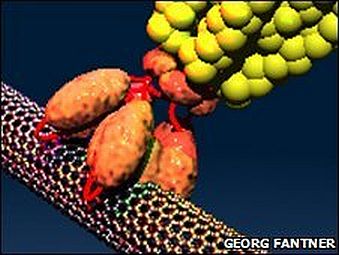
The prototype virus battery is a size of a coin and exhibit similar energy capacity and power performance as the rechargeable batteries used to power today's hybrid cars.
The team believes that with the current technology a larger model suitable to power mobile phones is now possible, however Professor Belcher admits that they are not going
to build larger models until they have the right material.
Another real world problem is that the current virus battery can only be charged and discharged up to 100 times.
Biofuel for powering our vehicles and machinery
The combustion of cellulosic ethanol fuel introduces some 85% reduction in
carbon emissions when compared to reformulated petrol.
While some additional greenhouse gases are emitted during fermentation stage as well, cellulosic ethanol is regarded as a biofuel or green fuel because
the plants absorb grater amount of carbon dioxide as they grow.
Additionally depending on the production method when compared to the fossil fuel petrol, ethanol could release less greenhouse gases.
Unfortunately only larger countries with enough spare land can afford to grow enough Biofuel crops to cover their entire fuel demand,
not a real option for all those smaller countries who have to prioritise on food production.
Study from 2007 compares some of the crops
that are used in US for ethanol production, and their effective reduction in greenhouse gas emission,
against the life cycle of petrol and diesel fossil fuels found to be around these figures:
- Corn and Soybean ~40%
- Reed canarygrass ~85%
- Switchgrass and
Hybrid Poplar are the best performers among the reviewed crops ~115%
The study excerpt doesn't mention the Sugar Cane, Oil Palm Trees used in Brazil and other tropical countries for ethanol production.
Currently nearly pure ethanol is sold in US under the trading name E85. It contains a mixture of up to 85% denatured ethanol and 15% unleaded petrol.
Since it has only 2/3 the energy of the petrol it is not very popular, but today's cars are designed to run on petrol, and there is no question there will be soon a
new generation of cars optimised for ethanol.
Caution is needed however as some warn: The future may not be as green as seams.
Welcome to second generation biofuel plants
Indeed the recent research shows that the current biofuels policies doubled the CO2 emissions.
Second generation biofuel plants would therefore have to meet certain social, technical and commercial criteria.
The Jatropha Curcas is a plant that meets these criteria (unfortunately it is not suitable for UK climate). It grows to approximately three meters high and can be grown in a range of difficult conditions,
including arid and otherwise non-arable areas, leaving prime areas available for food crops. Click on the picture for more info about the introductory video.

Since then the Continental Airlines Biofuel Twin-Jet has made a successful flight, using a blend of traditional petroleum-derived Jet A fuel,
and a mix derived from the Jatropha plant and above mentioned algae.
Wood
The wood from fast growing trees has also a more traditional use:
for heating,
as building material and
as row base material:

In the British climate willow is the fastest growing kind of tree, particularly the Salix Viminalis Hybrid Q83:

Grass
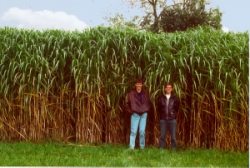
Yet another good combustible energy source is the tall perennial grass Miscanthus x giganteus originally from Japan, currently grown in the EU as a source of biomass:
Algae
A potentially "revolutionary" biotechnology is emerging that absorbs the CO2 and in turn produces biofuel on site.
The current model of a product by Origo Industries called
Ecobox can produce
up to 250 litres of biofuel a day using a photo-bioreactor containing algae, while the larger version capable of producing up to 3,000 litres a day is under way.

For those who are DIY minded here is a book about algae that produce Biodiesel.
Some other pages similar to this page:
Hydrogen on demand
The life on Earth depends on Carbon dioxide or CO2
Sustainable designs combat the climate change and help to save the planet
Sustainable housing projects
Could we save the planet by driving cars
Global warming and fuel economy
Sustainable Development in High Wycombe
Sustainable infrastructure to solve gridlocks, traffic issues / problems in High Wycombe